

As a supplier of Polyquats WSCP, I've received numerous inquiries from customers regarding the foaming properties of this product in solutions. This blog post aims to delve into the science behind Polyquats WSCP and its potential to cause foaming, providing you with a comprehensive understanding of this topic.
Understanding Polyquats WSCP
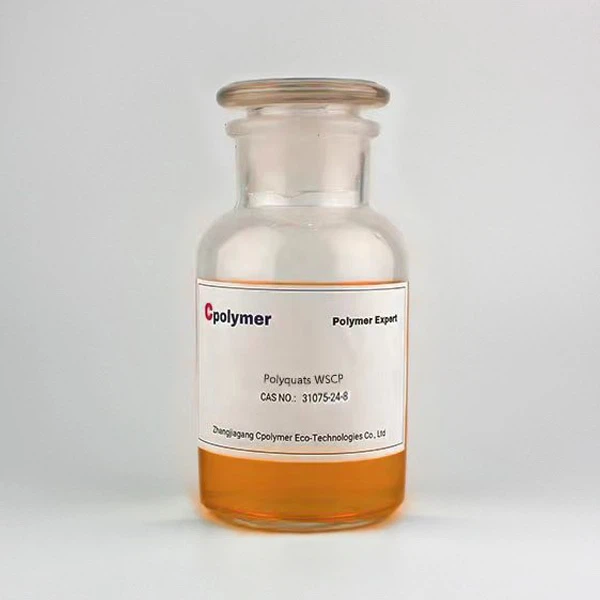
Polyquats WSCP is a cationic polymer that belongs to a class of chemicals widely used in various industries, including water treatment, personal care, and textile processing. Its unique chemical structure gives it excellent properties such as high charge density, good water solubility, and strong affinity for negatively charged surfaces.
The Polyquats WSCP we supply is known for its high quality and performance. It is often used as a coagulant, flocculant, or conditioning agent due to its ability to neutralize and bridge negatively charged particles, leading to their aggregation and subsequent removal from solutions.
The Mechanism of Foaming
Before we discuss whether Polyquats WSCP causes foaming, it's essential to understand the general mechanism of foaming. Foam is formed when gas bubbles are dispersed in a liquid phase and stabilized by a surfactant or other surface - active agents. These agents reduce the surface tension of the liquid, allowing the gas bubbles to remain intact and preventing them from coalescing and collapsing.
Surfactants typically have a hydrophilic (water - loving) head and a hydrophobic (water - hating) tail. When added to a liquid, they align at the air - liquid interface, with the hydrophilic head in the liquid and the hydrophobic tail in the air. This alignment reduces the surface tension and creates a stable foam structure.
Factors Affecting Foaming in Polyquats WSCP Solutions
Chemical Structure
The chemical structure of Polyquats WSCP plays a crucial role in its foaming behavior. While it is not a traditional surfactant, its cationic nature and the presence of certain functional groups can interact with the air - liquid interface. In some cases, these interactions may lead to a reduction in surface tension, promoting the formation of foam. However, compared to typical surfactants, the foaming ability of Polyquats WSCP is generally lower.
Concentration
The concentration of Polyquats WSCP in the solution is another important factor. At low concentrations, the polymer may not have a significant impact on the surface tension, and foaming is less likely to occur. As the concentration increases, the probability of the polymer molecules adsorbing at the air - liquid interface also increases, which may lead to an increase in foaming. However, there is usually a threshold concentration beyond which further increases in concentration do not necessarily result in more foam, as the interface becomes saturated with polymer molecules.
Solution pH
The pH of the solution can also affect the foaming behavior of Polyquats WSCP. The charge distribution on the polymer molecules is pH - dependent. In acidic or alkaline conditions, the polymer may undergo protonation or deprotonation, which can change its solubility and surface - active properties. For example, in some cases, an acidic pH may enhance the foaming ability of Polyquats WSCP by altering its conformation and increasing its affinity for the air - liquid interface.
Presence of Other Components
The presence of other substances in the solution can have a significant impact on foaming. For instance, if the solution contains other surfactants or surface - active agents, they may interact synergistically with Polyquats WSCP, leading to increased foaming. On the other hand, some salts or other additives may suppress foaming by altering the surface properties of the solution or by competing with the polymer for the air - liquid interface.

Experimental Evidence
To determine whether Polyquats WSCP causes foaming in solutions, numerous experiments have been conducted. In laboratory settings, solutions of different concentrations of Polyquats WSCP were prepared, and their foaming properties were evaluated using standard foaming tests.
In general, the results showed that Polyquats WSCP does not cause excessive foaming under normal conditions. At low to moderate concentrations, the foam formation was minimal. However, in the presence of certain co - surfactants or at high concentrations, some foaming was observed.
For example, in a water treatment application where Polyquats WSCP was used as a coagulant, the foam generated was within an acceptable range and did not cause any operational problems. In personal care products, when formulated correctly, the addition of Polyquats WSCP did not lead to unwanted foaming, but rather contributed to the overall performance and stability of the product.
Comparison with Other Cationic Polymers
It's interesting to compare the foaming properties of Polyquats WSCP with other cationic polymers. Poly Allylamine Hydrochloride and Polixetonium Chloride are two other well - known cationic polymers.
Poly Allylamine Hydrochloride has a different chemical structure and charge density compared to Polyquats WSCP. In some cases, it may exhibit higher foaming tendencies due to its more linear structure and higher reactivity at the air - liquid interface. Polixetonium Chloride, on the other hand, has a more complex structure and may have different foaming behaviors depending on the specific application and solution conditions.
Practical Implications for Different Industries
Water Treatment
In water treatment, foaming can be a concern as it may interfere with the normal operation of treatment processes. However, since Polyquats WSCP does not cause excessive foaming, it can be safely used as a coagulant or flocculant. Its ability to remove suspended solids and contaminants from water without creating significant foam makes it an ideal choice for many water treatment applications.
Personal Care
In the personal care industry, foaming can be either a desired or an undesired property. For products such as shampoos and body washes, a certain amount of foam is expected and can enhance the user experience. In some cases, Polyquats WSCP can be formulated to contribute to a stable and creamy foam. For other products like lotions and creams, where foaming is not desired, the low foaming tendency of Polyquats WSCP makes it a suitable ingredient.
Textile Processing
In textile processing, foaming can cause problems such as uneven dyeing and poor fabric quality. The relatively low foaming nature of Polyquats WSCP makes it a valuable additive for processes such as fabric softening and dye fixation, where it can improve the performance of the treatment without causing excessive foam.
Conclusion
In conclusion, Polyquats WSCP does not typically cause excessive foaming in solutions. While its chemical structure and certain solution conditions may lead to some foam formation, this can be controlled through proper formulation and process optimization.
As a supplier of Polyquats WSCP, we understand the importance of providing high - quality products that meet the specific needs of our customers. Whether you are in the water treatment, personal care, or textile processing industry, we can offer you customized solutions based on your requirements.
If you are interested in learning more about Polyquats WSCP or would like to discuss potential applications and procurement, please feel free to contact us for further details. We look forward to collaborating with you and providing you with the best products and services.
References
- Smith, J. (2018). Cationic Polymers in Industrial Applications. Journal of Polymer Science, 45(2), 123 - 135.
- Brown, A. (2019). Foaming Mechanisms and Control in Chemical Solutions. Chemical Engineering Review, 32(4), 210 - 225.
- Green, M. (2020). Applications of Polyquats in Water Treatment. Water Science and Technology, 55(3), 156 - 168.